
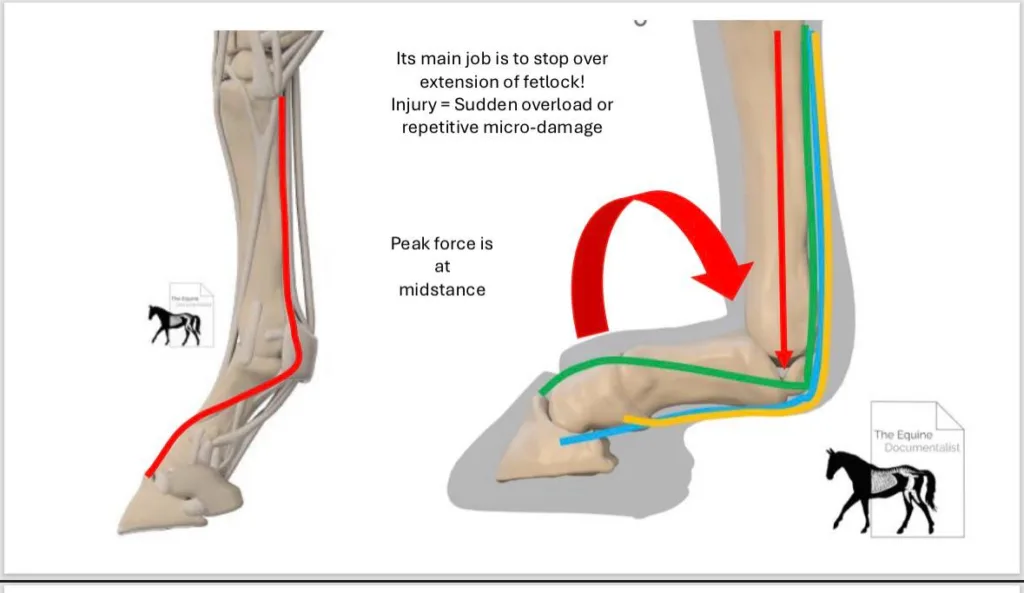
The primary mechanical role of the suspensory ligament is to resist excessive fetlock extension during stance. From a farriery perspective, this makes reduction of fetlock descent an obvious therapeutic objective. However, suspensory strain does not arise solely from fetlock overextension. A second, distinct mechanism exists: toe sinking on deformable surfaces, which increases suspensory strain without necessarily increasing fetlock extension. These two mechanisms must be considered separately, because they respond to opposing mechanical interventions.
Reducing fetlock extension on firm surfaces is most effectively achieved by increasing caudal ground support. Shoes that add caudal length, such as egg bars, create a rearward cantilever that limits fetlock descent by reducing the flexion moment acting about the metacarpophalangeal joint. This effect is well documented and consistent on non-deformable substrates, where toe penetration does not occur and toe-based pressure-dispersion strategies are mechanically irrelevant.
In contrast, on deformable surfaces the dominant suspensory risk is often toe sinking rather than fetlock hyperextension. And is often what farriery intervention is prescribed to address.

Forward concentration of the ground reaction force (GRF) relative to the Point of Balance (PoB) produces a forward pitch of the hoof as the toe penetrates the surface. This increases suspensory strain by altering distal limb loading geometry, even if fetlock extension itself is not increased. On these surfaces, widening the toe increases contact area and reduces local pressure, limiting toe penetration and forward pitch. Crucially, this intervention has no meaningful effect on hard ground, where penetration does not occur.
This creates a fundamental mechanical conflict.
Interventions that protect the suspensory from hyperextension on hard ground (increased caudal length) inherently increase the risk of toe sinking on soft ground, because they bias GRF distribution forward of the PoB during penetration. Conversely, interventions that reduce toe sinking (wide toe pressure dispersion) are only effective on deformable surfaces and do not counteract fetlock extension on firm ground.
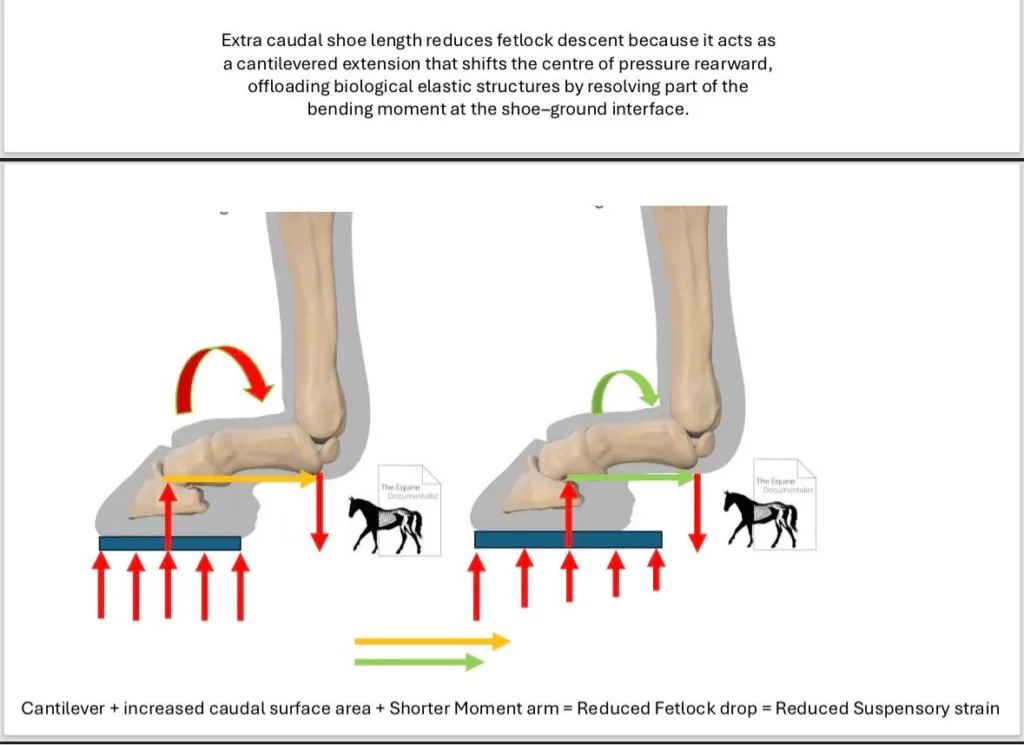
Experimental data support this asymmetry. Hagen et al. And Reilly et al. demonstrated that shoes with increased caudal extension produce more consistent and repeatable changes in hoof orientation and distal limb mechanics than wide-toe designs. They showed that egg-bar shoes generate a greater forward hoof pitch on deformable surfaces than a wide-toes consistency in providing the opposing orientation, indicating that caudal extension tends to mechanically dominate when both are applied concurrently. As a result, in horses working across mixed surfaces, the egg-bar effect may override or negate the intended soft-surface benefit of a wide toe.
An additional and frequently overlooked variable is base proportion relative to the PoB. When a wide toe is applied without addressing base proportions, particularly when the shoe is positioned around the centre of rotation or with excessive caudal length, the resulting GRF distribution promotes forward pitch on soft surfaces. In this situation, the wide toe is mechanically forced to oppose the imposed GRF pattern and may be partially or completely cancelled out. In contrast, when a wide toe is coupled with base proportions that place the effective ground contact appropriately relative to the PoB, pressure dispersion and GRF alignment act synergistically, substantially improving efficacy on deformable footing.
Key principle:
Farriery for suspensory injury cannot be surface-agnostic. Fetlock hyperextension and toe sinking are mechanically distinct causes of suspensory strain, and the interventions for one may worsen the other. Effective management therefore requires explicit consideration of:
• surface type (hard vs deformable),
• PoB-dependent GRF distribution,
• base proportions,
• and the mechanical dominance of caudal extension versus toe pressure dispersion.
Without this framework, well-intentioned interventions may neutralise each other, or exacerbate the very strain they are intended to reduce.

