
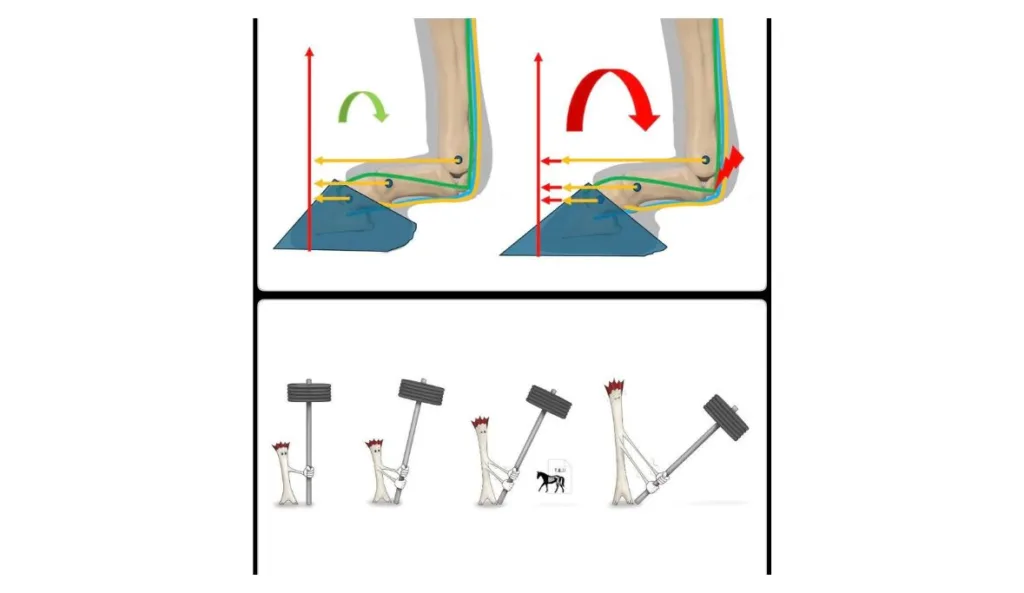
The modern debate surrounding “toe levers” within equine hoof care has become increasingly polarised. A particular rehabilitation-oriented school of thought has recently attempted to argue that toe levers do not exist through engineering-style calculations examining hoof wall deformation and stress during breakover. The resulting conclusion has then been generalised into a broader claim that long toes are not biomechanically problematic and that much of traditional farriery concern surrounding toe length is fundamentally misguided.
The issue with this argument is not primarily the mathematics. The issue is that the mathematics is answering a very specific structural question within a very particular pathological context, while the resulting conclusions are being incorrectly exported into normal locomotor biomechanics and performance horse mechanics.
This distinction matters enormously because the term “toe leverage” has historically been used by clinicians, veterinarians, and farriers as shorthand for multiple interacting biomechanical phenomena, not simply for catastrophic dorsal wall avulsion during breakover. The current debate therefore represents a collapse of biomechanical context. Different groups are discussing fundamentally different problems while using the same language.
The central question is not whether a healthy hoof wall catastrophically peels away from the distal phalanx during normal locomotion. Very few serious practitioners have ever argued that this is the primary mechanism underlying long toe pathology in healthy horses. The real biomechanical discussion has historically centred around altered centre of pressure position, altered external moment arms, altered breakover timing, increased rotational demand around the distal interphalangeal joint, increased recruitment of the flexor apparatus, altered strain timing, and increased cumulative loading of the soft tissue structures of the distal limb.
These are entirely different questions.
The engineering calculations currently being circulated largely examine the structural behaviour of the dorsal hoof wall under loading. They model the hoof wall as a mechanically robust curved structure possessing substantial resistance to deformation. In many respects this is unsurprising. The hoof capsule is not a weak isolated cantilever beam. It is a highly specialised anisotropic composite structure designed to withstand enormous repetitive loading cycles. Hoof horn demonstrates regional variation in elastic modulus, viscoelastic behaviour, time-dependent deformation characteristics, and structural reinforcement through tubular orientation and capsule geometry. The dorsal wall exists as part of an integrated three-dimensional capsule rather than as an isolated plank projecting from the front of the foot.
The problem arises when this structural observation is transformed into the broader claim that “toe levers do not exist.”
What has actually been demonstrated is that the healthy hoof capsule possesses substantial structural safety margins under normal loading conditions. This is not equivalent to demonstrating that toe length is biomechanically irrelevant.
Disproving catastrophic dorsal wall avulsion does not disprove lever-arm mechanics.
This distinction is critical because most farriers discussing “toe leverage” are not referring to hoof wall detachment. They are discussing the mechanical consequences of altering the spatial relationship between the centre of pressure, the centre of rotation, the ground reaction force vector, and the internal flexor apparatus of the distal limb.
As toe length increases, the centre of pressure migrates dorsally relative to the distal interphalangeal joint and associated centres of rotation. This alters the external moment arm acting upon the digit. Increased moment arm length increases rotational demand around the distal limb joints and increases the internal force required from structures such as the deep digital flexor tendon in order to maintain equilibrium. This is basic mechanics. Longer external lever arms require increased internal counter-moments if equilibrium is to be preserved.
Importantly, these effects are not limited to peak force magnitude alone. Time matters. Breakover duration matters. Impulse matters. Repetitive cyclic loading matters. A horse may not experience catastrophic failure during a single stride while still accumulating increased cumulative strain across tens of thousands of loading cycles.
This is particularly important because the distal limb functions as a coupled elastic system. The deep digital flexor tendon, navicular apparatus, distal sesamoidean ligaments, collateral ligaments, and associated soft tissues all participate in load sharing throughout stance. Increasing external lever arms alters the temporal and spatial distribution of this load sharing. The result is not necessarily dramatic visible failure but altered mechanical demand over time.
The current argument against toe leverage therefore relies heavily on redefining what practitioners historically meant by the term in the first place.
This contextual collapse becomes even more problematic when laminitis enters the discussion.
The rehabilitation cases often cited in support of the “toe levers do not exist” position are frequently chronic laminitic rehabilitation cases involving retained lamellar wedges being allowed to grow out over time. These cases are then used to imply that toe length is generally biomechanically irrelevant. This is a profound contextual error because a metabolically stabilised chronic laminitic horse undergoing controlled rehabilitation is not mechanically equivalent to either an acute laminitic horse or a healthy performance horse.
In acute laminitis, the primary issue is not normal structural loading of healthy tissue. The primary issue is pathological failure of the lamellar suspension system itself.
The lamellae function as a suspensory attachment apparatus between the distal phalanx and the hoof capsule. During acute endocrinopathic or septic laminitis, inflammatory and metabolic processes compromise the integrity of this attachment system. Tensile strength decreases. Structural tolerance decreases. Mechanical safety margins collapse. Under these conditions, even relatively modest mechanical forces may become clinically important because the tissue itself is no longer functioning within normal physiological limits.
This principle is universal in biomechanics and engineering. A structurally healthy bridge may comfortably tolerate forces that become catastrophic once the supporting materials are chemically degraded or partially ruptured. Demonstrating that an intact bridge tolerates normal loading does not prove that damaged bridges are safe under identical conditions.
Likewise, demonstrating that a healthy hoof capsule possesses substantial structural robustness does not disprove the importance of leverage reduction during acute lamellar failure.
This is where much of the current debate becomes confused. The retained lamellar wedges observed in many successful rehabilitation cases are often being managed after the primary inflammatory drivers have already been brought under control. The horse is no longer in the same pathological state as during acute active lamellar separation. The tissue is stabilising. The horse is often moving at relatively low intensity. Loading is controlled. The objective is gradual mechanical and biological recovery while preserving as much hoof capsule integrity as possible.
Under these conditions, it is entirely possible that retaining dorsal wall structures and allowing pathological horn to grow out gradually may produce good outcomes. In fact, there may be important lessons within these rehabilitation systems regarding preservation of hoof capsule integrity, avoidance of excessive dorsal wall weakening, and management of chronic lamellar pathology.
However, none of this demonstrates that long toes are biomechanically neutral in healthy athletic horses.
This is the key scientific mistake currently occurring within the debate: treatment principles derived from chronic pathological rehabilitation are being exported into normal locomotor biomechanics without contextual normalisation.
A horse quietly growing out a retained lamellar wedge during controlled rehabilitation is operating under fundamentally different mechanical conditions than a performance horse repeatedly loading the distal limb under high impulse athletic locomotion.
A polo pony accelerating and turning on turf, a racehorse galloping at speed, or a jumper repeatedly loading the distal limb during landing is not mechanically equivalent to a chronically rehabilitating laminitic horse walking under controlled conditions. The magnitude, timing, frequency, and directionality of forces are entirely different.
Under high-performance locomotion, centre of pressure position, breakover timing, lever arm length, rotational equilibrium, and internal soft tissue demand become increasingly important because loading magnitude and impulse increase dramatically. In these contexts, excessive toe length may significantly alter distal limb mechanics even if the hoof wall itself remains structurally intact.
This distinction also explains why many experienced clinicians can simultaneously recognise the structural robustness of the hoof capsule while still considering long toes biomechanically undesirable in performance horses.
The hoof can be structurally strong while the locomotor mechanics remain inefficient.
These are not contradictory statements.
The current debate has therefore become trapped within a false binary. Either toe leverage is treated as a catastrophic peeling force destroying the hoof capsule, or leverage is declared entirely fictional because the capsule survives normal loading. Reality is considerably more nuanced.
The hoof capsule is a remarkably sophisticated biological structure possessing substantial structural redundancy and adaptive capacity. However, the distal limb is also an extraordinarily sensitive mechanical system in which relatively small geometric changes alter moment arms, timing relationships, and internal tissue demand across millions of repetitive loading cycles.
Both statements can be true simultaneously.
Ultimately, the current controversy is less about mathematics than about scale and context. The engineering calculations examine one narrow structural question within one pathological framework. They do not invalidate the broader biomechanical principles governing locomotion, rotational equilibrium, force distribution, and soft tissue loading within the athletic horse.
The real scientific error is not in recognising the structural robustness of the hoof capsule. The real error occurs when conclusions derived from chronic laminitic rehabilitation are generalised into universal principles of normal equine biomechanics without accounting for the radically different mechanical environments involved.
Maintaining hoof capsule integrity during chronic laminitic rehabilitation may indeed be an area where this rehabilitation-oriented school has valuable lessons to offer. But the existence of successful chronic rehabilitation cases does not abolish lever mechanics, abolish moment arms, abolish centre of pressure migration, or abolish the importance of breakover geometry during high-performance locomotion.
The hoof is structurally robust.
The distal limb remains biomechanically sensitive.
And pathology changes the meaning of force entirely.
That is the context currently missing from the modern “toe lever” debate.

